Showing posts with label Luke. Show all posts

Friday, 22 October 2010

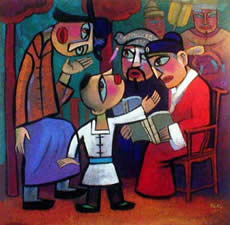
Jesus reads from the scroll of Isaiah


Luke 4:14
Jesus returned to Galilee in the power of the Spirit, and news about him spread through the whole countryside. 15He taught in their synagogues, and everyone praised him.
 16He went to Nazareth, where he had been brought up, and on the Sabbath day he went into the synagogue, as was his custom. And he stood up to read. 17The scroll of the prophet Isaiah was handed to him. Unrolling it, he found the place where it is written:
 18"The Spirit of the Lord is on me,
      because he has anointed me
      to preach good news to the poor.
   He has sent me to proclaim freedom for the prisoners
      and recovery of sight for the blind,
   to release the oppressed,
    19to proclaim the year of the Lord's favor."[e]
 20Then he rolled up the scroll, gave it back to the attendant and sat down. The eyes of everyone in the synagogue were fastened on him, 21and he began by saying to them, "Today this scripture is fulfilled in your hearing."
 22All spoke well of him and were amazed at the gracious words that came from his lips. "Isn't this Joseph's son?" they asked.
 23Jesus said to them, "Surely you will quote this proverb to me: 'Physician, heal yourself! Do here in your hometown what we have heard that you did in Capernaum.' "
 24"I tell you the truth," he continued, "no prophet is accepted in his hometown. 

Jesus wasn’t a carpenter. I don’t think so. When I hear people say that he was, I am intrigued – why do they think that? Yes I know his dad was a carpenter, but I think Jesus was a rabbi.

You see, the Jewish people sent their children to school. At the age of six they sent their boys and perhaps their girls to learn the Torah. They would memorise the Torah – Genesis, Exodus, Leviticus, Numbers, Deuteronomy…. all off by heart. At the age of 10 the best ones would stay on at school, those who had managed this feat. However, most would go off and learn their father’s trade at that point. I think Jesus was still at school aged 12, because we learn about his visit to the Temple, when he was left behind, and how amazed the rabbis were amazed at his questions and his understanding. Presumably he was asking them about the scriptures.

Those that stayed would go on to memorise the rest of the Hebrew scriptures – Genesis all the way through Malachi, off by heart. They would stay at school until they were fourteen or fifteen, and then most would go and learn their father’s trade. However, the very best, who had accomplished this would carry on with their learning. I can’t imagine it was many, a tiny percentage.

These few would go and find a rabbi and become a disciple – I disciple doesn’t just want to know what the rabbi know he want to be like the rabbi is. Now the rabbis had different understandings of the scriptures, different interpretations, and that rabbi’s teachings were known as that rabbi’s ‘yoke’. So if you wanted to follow a particular rabbi, you wanted to take on that particular ‘yoke’. So, aged fifteen a boy would find a rabbi and go for an interview. He would be grilled, and at this point most would fail, however, if they were really impressive, then the rabbi would say ‘come and follow me’. And then the kid would leave his family and his village and his friends. Each rabbi would travel, and go from town to town, teaching the scriptures, followed by his disciples. By the end of the day the disciples would be covered in whatever the rabbis would have stepped in. And so there was a saying ‘may you covered in the dust of your rabbi’.

The rabbis were the most respected people, and hence if you had a child in your village who had managed to be so learned and find a rabbi, how would you feel? Pretty good. Your village would be on the map, your villagers aren’t stupid, they are clever. And I believe this is what happened to Jesus. He was the best of the best of the best. He left Nazareth aged fifteen, he was a disciple until he was thirty, which is the age at which they were expected to find their own disciples. This passage is set after he is baptised and before he has called the disciples. He comes home at the end of his training, when he no longer has to be in the dust of his rabbi.

Now Nazareth was a very small place and quite remote – everyone would know everyone and probably be related to everyone. I can imagine that this was the first rabbi they had ever had. They were proud of him. They heard reports that he had preached amazingly in the synagogues in the area. They probably hadn’t seen him since he was fifteen. They were all loving seeing him – wow hasn’t he grown? Doesn’t he speak graciously?

And then Jesus says something that at first seems paranoid, he says ‘no prophet will be accepted in his home town’. He then preached a sermon. He has read a scripture that is radically inclusive, inclusive of the poor, the oppressed, the blind, the prisoners. And then if you read on in the scriptures he tells them that God loves the foreigners, the outsiders, the Gentiles as much if not more than them.

And their reaction? They dragged him out of the synagogue, out to the edge of the cliff that their village was built on with the intention of throwing him over. He escaped. Wow – overreaction or what???
And so.. the moral of the story is that Jesus started his manifesto proclaiming inclusivity and healing, he wanted to embrace the outcasts, the criminals, the poor, the oppressed, the people who are different to those who were in the synagogue. He then illustrated this by saying that God loved foreigners and demonstrated this in history, and it made people mad and want to kill him.

This could sum up Jesus’ ministry all the way through. He said God loved the unlovable and that made people so uncomfortable that they wanted to kill him.

So the first thing to note is that the trick is to be like Jesus and not like the ones who hate. Who makes us uncomfortable? I noticed a couple of groups this week, one was some people who argue that selling sex for money is good, and the other was a group of who say that women shouldn’t be vicars, and have a strong desire to outline exactly what is proper for a woman to do. Both times I had an emotional revulsion that is different to just disagreeing. I wanted to shut them up rather than engaging, or agreeing to differ. It is those revulsions that tear our world apart, not disagreement, which can be generous and constructive. I needed to repent of those feelings, to recognise them for what they were and not justify them.

At the moment, the Archbishop of Canterbury, Rowan Williams is in India, and in a that sermon he preached he said:
"Sometimes we have listened to our own unconverted hearts and used the church of God for our own ends, welcoming people like us and rejecting those who make us uncomfortable. And when any of those things happens, the Church begins to fall apart. The wounds in the Body get wider and deeper, and we find ourselves giving great energy to justifying our decision not to be together. As we stop listening to one another, we stop listening to Christ. Whether this happens in the name of nationality or tradition or pride of achievement or purity of teaching, the effect is the same tragedy."

So having decided that we are not going to be on the side that is revolted by people, but be will be on the side that includes people, what does that mean to us? Well I think it is Good News for two reasons:

The first reason is that we are included. We are the foreigners, the Gentiles that Jesus is talking about. It is us that he loves and us to whom the Day of the Lord’s Favour has been announced. We are the ones who are released, healed, given sight to. For so many people there is the fear that if others knew what we were really like they would reject us, the fear deep down that we are unworthy, the reality that we can be nasty and we are ashamed. We can be oppressed by these fears, in prison if you like. Jesus wants to set us free. He knows what we are like and includes us anyway.

The second reason that it is good news is that we have a job to do, and it is a great job. It is to make the entire world a better place. It is to go round freeing captives, healing the blind, helping the poor. We are to be Jesus’s disciples, covered in his dust, completely dedicated to the mission he has given us, wearing the Yoke of his teachings and enabling all to be included. Of course some people won’t like it, and it will make them very cross. But I can’t think of a better way of living my life than this.

Thursday, 7 October 2010

The Ten Lepers


A pastor starts each confirmation class with a jar full of beans. He asks his students to guess how many beans are in the jar, and on a big pad of paper writes down their estimates. Then, next to those estimates, he helps them make another list: Their favourite songs. When the lists are complete, he reveals the actual number of beans in the jar. The whole class looks over their guesses, to see which estimate was closest to being right. He then turns to the list of favourite songs. "And which one of these is closest to being right?" he asks. The students protest that there is no "right answer"; a person's favourite song is purely a matter of taste. He then asks "When you decide what to believe in terms of your faith, is that more like guessing the number of beans, or more like choosing your favourite song?"

When I read the gospels, the stories are always odd in some way,  they perplex me. The gospels do not offer us rules, they give us something to wrestle with, to chew on. They are odd. The way of faith that Jesus offers is not prescriptive – it is more like our favourite song than the number of beans in a jar. Sometimes my atheist friends argue with me – they say the stories are so ambiguous in the Gospels that we can take anything from them. They say that the diversity of Christian beliefs is so varied that it is impossible to pin us down. Precisely, I want to say – it is a journey, not a destination. I offer that to you as a health warning for my sermons. When I preach I have been wrestling with a text for a week and I offer my musings for you to chew on, but they are just that – musings… not definitive rules. It is a journey of faith, not certainty, and I believe there are no right answers.

So what about today’s passage – simple? Jesus heals ten lepers and only one comes back to say thanks and Jesus commends him – right? Well… my understanding is that all ten lepers had faith – they asked Jesus to heal them, he told them to show themselves to the priests and on the way they were healed, and so one of them failed to do what Jesus asked and came back to say thanks, and Jesus commended that man and said that his faith had saved him. Saved him from what? Not the leprosy is it? Anyway, what faith? Why does it take faith to go back and say thank-you?

Mmm… so Jesus tells them to do something, one of them doesn’t and he gets commended? Oh and he is the disgusting foreigner who worships on the wrong mountain and has the wrong religion too. It reminds me of a parable by Pete Rollins, of a kind man in a city who one night is woken by someone knocking on his door. It is a man seeking refuge having done the unspeakable crime. He lets him in and goes to bed. Soon afterwards, more men are knocking at the door, they say that God’s law requires for the man to pay with his life for the unspeakable crime. The kind man tells then that he is well aware of God’s law but will not let the criminal be killed. He goes back to bed only to be woken by the elders of the city who command the kind man to release the criminal. The kind man is pretty determined and says no, and goes to bed. So finally, he hears a knocking at the door and when he opens it God is standing there. God demands that the kind man hands the criminal over, but the man refuses. He says that the God that he knows is compassionate and merciful, and he requires God to act within his character and to have mercy on the criminal. To this God replies, ‘you know me better than anyone in this city, and you are right not to release the criminal to me, you are a man of great faith'.

Last week the reading told us about how we can do amazing things with just a little faith. Today’s passage speaks to me of how we can break away from the crowd with a little faith. The ten lepers knew what they wanted and they wanted to be back in society and without their disease. They had enough faith to ask for a miracle, enough faith to move a mountain, and that was great. But the one leper had enough faith to break away from the crowd, break away from the law. When he was healed he didn’t want to go and show himself to the priests to fulfil the law, he wanted to celebrate, and to thank God, and thank Jesus. He was the only one who ended up truly free to be and do his heart’s desire. The nine lepers were saved from their disease, the Samaritan leper was saved from the law.

It reminds me of a passage in Chapter 3 of the book of Galatians:
You foolish Galatians! Who has bewitched you? Before your very eyes Jesus Christ was clearly portrayed as crucified. I would like to learn just one thing from you: Did you receive the Spirit by observing the law, or by believing what you heard? Are you so foolish? After beginning with the Spirit, are you now trying to attain your goal by human effort? Have you suffered so much for nothing—if it really was for nothing? Does God give you his Spirit and work miracles among you because you observe the law, or because you believe what you heard?
Paul is worried that the Galatians are missing the whole point, others are telling them that faith and freedom in Christ wasn’t enough – they had to abide by the Jewish law too. People usually take refuge in the law when they get frightened of living by faith. You know where you are with the law, but living by faith can be a bit of a risk. Is my faith one of following the rules? Is my God a hard task-master, or a loving and forgiving God.  Am I one of the nine lepers, or am I like the Samaritan? Perhaps I need the courage to live by faith, perhaps the courage to be myself.

So may you know that God has given you the gift of faith
May you not be afraid but find salvation and freedom
And may you know joy like the Samaritan Leper
Amen

Thursday, 30 September 2010

Faith the size of a mustard seed


Luke 17:5-10 (New International Version)
5The apostles said to the Lord, "Increase our faith!"
6He replied, "If you have faith as small as a mustard seed, you can say to this mulberry tree, 'Be uprooted and planted in the sea,' and it will obey you.
7"Suppose one of you had a servant ploughing or looking after the sheep. Would he say to the servant when he comes in from the field, 'Come along now and sit down to eat'? 8Would he not rather say, 'Prepare my supper, get yourself ready and wait on me while I eat and drink; after that you may eat and drink'? 9Would he thank the servant because he did what he was told to do? 10So you also, when you have done everything you were told to do, should say, 'We are unworthy servants; we have only done our duty.' "


I want to think a bit about faith. Let me tell you a story:

Jean François Gravelet, "The Great Charles Blondin", was a famous French tightrope walker and acrobat.
Blondin's greatest fame came in 1859 when he attempted to become the first person to cross the rushing and roaring waters of Niagara Falls on a tightrope.

With a balancing pole, Charles Blondin walked across the 335m long tightrope in only five minutes. He went on to walk across the falls several times, each time with a different theatrical flair. Later crossings were made in a sack; on stilts; on a bicycle, in the dark with sparks flaring from his pole tips; with his hands and feet manacled; and sitting down halfway to cook an omelet!

On one such occasion a large crowd gathered as word went out that Blondin was going to attempt yet another incredible feat. A buzz of excitement ran along both sides of the river bank. The crowd “Oooohed!” and “Aaaaahed!” as Blondin carefully walked across one dangerous step after another -- blindfolded and pushing a wheelbarrow.

Upon reaching the other side, the crowd's applause was louder than the roar of the falls! Blondin suddenly stopped and addressed his audience: "Do you believe I can carry a person across in this wheelbarrow?"
The crowd enthusiastically shouted, "Yes, yes, yes. You are the greatest tightrope walker in the world. You can do anything!"

"Okay," said Blondin, "Get in the wheelbarrow....."

No one did!

It’s one thing to believe, it's another thing to take a step of faith based on that belief. Belief must be followed by action if it is to take you where you want to go!

How many sermons can you remember? Be honest…. I can’t remember many. But I remember one in particular one on Ephesians 2:7-9

“In order that in the coming ages he might show the incomparable riches of his grace, expressed in his kindness to us in Christ Jesus. For it is by grace you have been saved, through faith—and this not from yourselves, it is the gift of God— not by works, so that no one can boast.”

My vicar pointed out that the Bible tells us that faith is a gift from God. At the time I was struggling with my faith, and I don’t know about you, but I can’t work faith up in myself. You know the sort of thing – if I try really, really hard I can have more faith. Bit like saying ‘whatever you do – don’t think about pink elephants’. Some things simply don’t seem possible. I can remember the relief sinking into me as I realised.. its ok.. faith is a gift… it isn’t my fault that I don’t have much faith.

I am a horrible sceptic at times. I know some people have others come up to them and say ‘I wish I had your faith’. No one ever says that to me!

I can be a bit like Woody Allen, who said, ‘I would believe if only God would give me some clear sign! Like making a large deposit in my name in a Swiss bank.’

Or another of Woody Allen’s sayings: ‘How can I believe in God when just last week I got my tongue caught in the roller of an electric typewriter?’

Sometimes, when I heard stories like the one about the tightrope and the wheelbarrow I felt guilty. But I don’t any more. You see I believe that God gives us faith. Perhaps it is only a tiny, tiny amount, like a mustard seed, which was the tiniest seed. But that tiny amount can do amazing things.

I have been inspired by a friend of mine who has improved the public health of the UK without hardly anyone noticing. (Some people clearly have noticed, because he is a bit older than me, and has already received a lifetime achievement award). It hasn't been without sacrifice. He has been threatened by big multinational companies and feared at times that he would lose his house.

He is a lobbyist. Not the sort that stands outside with placards, but the sort that does careful research and meets with people who can change things. He is a politician, in the sense that he is very political, saying that politics is about carefully working through your argument, and seeing things from the perspectives of others, especially those who oppose you.

How do you think our food in the UK came to be labelled with the calories, fat content and salt content? How do you think 'Healthy Eating' became a big issue in our schools? How is it that childhood obesity is now reducing? These things were, in my opinion, achieved by my friend, and of course his friends, and by lobbying and politics.

With a bit of faith, little people like me and you can make a massive difference in the world. For me, I desperately want the Church of England to change. I want it to be radically inclusive, as this is how I see Jesus in the Gospels. I long for complete and unequivocal equality between men and women, between gay and straight people, between married and divorced people. I also want to help save the planet, I want to see the parsonages and churches in our diocese carbon neutral.

Has God given you a tiny bit of faith? I bet God has. Did you know that with that tiny bit of faith you can tell mulberry bushes to go and take a running jump, or to move mountains…. Seriously, it is amazing what can be done. I have been working on a little project myself recently.. for a year, I suppose, and now it is gathering momentum, and all I have done is some research and I have talked to people about it.. at every opportunity. The galling thing is that no one really knows that it is me that has started the ball rolling. There is no glory in it. 

And that leads me to the second part of the reading. So often we get offended if we aren’t thanked and acknowledged, if we don’t get the glory, and if it doesn’t turn out exactly as we envisaged. But that stands in the way of progress, I believe.

I think we all want God’s kingdom to come on earth, sometimes it is our pride that clogs the whole thing up. We need to just see it as something ordinary, that we are like servants, put on this earth to do our bit. And whether that bit is at work or in the home or in the community or in the nation, whether it is to do with spiritual things or material things, all of it is part of our calling, and it is better if we are simply satisfied that the job is done rather than requiring praise from others.

So may you know that you have the gift of faith
And that a tiny amount of faith can move mountains
And may your faith and mine make this world a better place for all
Amen.

Thursday, 23 September 2010

Rich man and Lazarus

Luke 16:19-31


Perhaps it is as a result of doing work on a listed building, but I love that joke that goes ‘How many English Heritage workers does it take to change a lightbulb?’ …. CHANGE????
I have heard a few Christian versions of this too:

Charismatics : 10
One to change the bulb, and nine to pray against the spirit of darkness.

Free Church: At least 15.
One to change the light bulb, and three committees to approve the change and decide who brings the potato salad.

Church of England: 3
One to call the electrician, one to mix the drinks and one to talk about how much better the old one was.

Mormons : 5
One man to change the bulb, and four wives to tell him how to do it.
……………

Sorry, back to the passage, which I feel is about change, but not really about lightbulbs. Let’s look at the passage in a bit more detail. Many of you will know that I don’t believe in Hell. Personally, I feel God has got to be more compassionate, loving and forgiving than me, and the notion of Hell doesn’t stack up for me. I also feel that in the Bible, passages such as this one are interpreted as Jesus teaching about Hell, but I feel that is a misunderstanding.

Many scholars believe that Jesus is drawing upon a popular Jewish folk tale that had roots in Egypt about a rich man and poor man whose lots after death are completely reversed. The parable doesn't have to be true in all its particulars, but the people can relate to its stereotyped characters -- rich man, poor man, and Father Abraham.

The story has some surprising elements – the first is that the rich man and poor man have their fortunes reversed. The second is that the Rich Man doesn’t have a name, but the poor man does – Lazarus. Mentioning the name gives a sense that the poor man is more important than the rich man. And finally, the culture at the time felt that riches were a sign of God’s blessing and poverty a sign of sin. Hence when Jesus said ‘it is easier for a camel to get through the eye of a needle than a rich man get into heaven’, the disciples were amazed – if a rich man can’t get into heaven, then who can?

Jesus suggests that the prophets all through the ages have pleaded with the people to share their riches, and the people have taken no notice. Furthermore, even if he dies and is raised from the dead, people will take no notice of the message. They won’t change. Well that is pretty depressing. I like to think that Jesus was just feeling frustrated, and that we aren’t all destined to continuously behave poorly without changing for ever.
So do we change? And what would we want to change?

I’ve heard quite a bit about money recently. I was listening to the Jeremy Vine show, where a Marxist and a Capitalist were having a right verbal fisty-cuffs. What they did agree on was that the economy was messed up this time by cynical, unregulated greed. That in the past people bought shares in companies because they believed in them, now it is simply about making a quick buck. Also, money was leant to people who could never pay it back, on the gamble that when their houses were repossessed, the money would be recouped that way. Very nasty.

I also went to a lecture by Bishop Peter Selby who has published a book about the Biblical model for handling our money. The Bible is very clear that no interest should be paid on loans at all. He said that we needed to reinterpret these things for a modern society, and he also said the Bible was far clearer about sins to do with money than it is about things like homosexuality, and yet we all happily get mortgages, at the same time as condemning people with different sexual ethics than ourselves.


I also heard that the most fair society would be one where we all together agreed the rules, the wages, the terms, and then instantly died and were raised again randomly into a job, a country, a social grouping not of our choosing. The idea being that we wouldn’t mind who we were raised to be if it was all equal.


I believe that we are happiest if we share what we have, if we restrict how much we owe and if we limit our greed. I feel I am probably preaching to the converted here, but perhaps today is a day when you would like to review how much you share of you money and how ethical your investments and borrowings are. But please promise me that if you do review this, that you won’t do it out of guilt. I think guilt is a horrible reason to share our wealth, doing it out of an overflowing of compassion and love makes us joyful givers. Perhaps before giving we need to ask God for the gift of compassion.

I have heard it said that the last part of a man to be converted is his wallet. I must say I don’t really believe it. I think each one of us have sticking points. For some it is money, perhaps because they are afraid of poverty, perhaps because of parental messages. But not all of us have the same places where we get stuck, where we never change, where it seems that the stuck-ness has such immense power over us that even if someone came back from the dead it wouldn’t shift. Let me tell you a story:

In India Elephants are very useful for moving logs and generally shifting stuff, and that is what they do during the day, but they are very powerful creatures, and what do you do with them at night? How do you know that they aren't going to crush houses in the village etc? Well, when they are very small they are chained to metal posts by very large chains, and as much as they want to wander off, they can't. As they get older the chain is made smaller and smaller, until as adults, the elephants can be tethered by slipping a thin cord around it's neck and throwing it over a fence.

For us, sometimes things like the fear of poverty or the fear that we are not good enough are like the ropes that hold the elephants. Our negative beliefs tether us. We would like to change, we would like to be free, but we feel we can’t. Do you know which areas they are for you? Do you get stuck over money, or something else? I find for myself that one of the benefits of getting older is being aware of the buttons that people can press to set me off. The sad thing is I am not resolving them at the same rate at which I am discovering them, and so I am ever more aware of my sins.

The good news is, I think, that when we admit to ourselves, to God and sometimes to others the places where we are stuck, they often lose their power, and we can begin to change. The old fashioned word for this is repentance. I believe this gives us freedom, freedom from sin, from the things that make us stuck, and freedom to have life in all its fullness.

So may you know the power of the risen Jesus to change you
May you be honest with yourself before God
And may your money always be a blessing to you and to others
Amen

Saturday, 11 September 2010

Lost Sheep and Lost Coin


These stories of the lost sheep and the lost coin show me that I have a long way to go in terms of my understanding of God. Let me try to explain:

Jesus is trying to give an idea about what God is like. If you or I were trying to do this, what would we say? Perhaps we would identify a strong and wise father, who loves his children, who has time for them and nurtures them? Perhaps we would associate God with a teacher, strict but fair, endlessly encouraging us to do better. Perhaps God is distant and a bit cool, holy and awesome and judgemental. What is God like? All-powerful? All-knowing? Purposeful? Unchanging? Perhaps God is kind, forgiving, tender. Does God prefer upright people, or people with loose morals? What does Jesus say God is like?

First he chooses a shepherd. Now shepherds were the lowest of the low in society, they had a rubbish job, out on the hillsides, wandering looking for pasture for the sheep that normally belonged to someone else. The shepherds had to lie in the gateway of sheep folds at night to protect the flock from wolves, people didn’t queue up to take these jobs. Furthermore, shepherds were reputed to be light fingered, perhaps no surprise as they were so poor. I imagine shepherds as young boys, their first job being looking after sheep. Is all this a natural image for God? Furthermore, the shepherd boy that Jesus chooses isn’t the sharpest tool in the box. No one would leave ninety-nine sheep unattended to look for one; goodness knows how many more he will lose. Jesus listeners would feel incredulous at this point in the parable. How is God like a stupid shepherd boy?

To make matters worse, Jesus then suggests God is like a woman. The ten coins would probably be her dowry, and so she would be merely a young teenage girl, poor too, so if she lost her dowry she would not be able to marry and have no security. We can see she is poor because she has to light a lamp, peasant houses normally didn’t have any windows, Desperately, she sweeps, cursing herself for losing something so vital.
I wonder whether we would see God in a dim shepherd boy, or in a careless young girl. These two events could have been the most stupid things they ever did. If we were their mum or dad, I doubt we would be too impressed. But Jesus sees things differently; he has compassion on them and in their actions sees the purity of their desire to find the thing that is missing and their vulnerability in having lost something.

I don’t know whether you can bring to mind a time when you have been stupid lately? Something where the memory of it makes your toes curl, and if you recounted the story you would be very embarrassed. I am afraid I have so many to choose from. Take a moment to remember the event and how you felt. If you really can’t then perhaps it is easier to remember something that your children have done that is unwise, or perhaps something you did as a child that was mistaken. There is the sting of embarrassment of having made a mistake, especially if it is exposed. But is that how God sees us? Is it possible that God sees our good intentions, our hopes and desires, however misguided? Is it possible that God has masses more patience and kindness than us and even in our lowest moments can be used as a metaphor for an aspect of God? The passage speaks to me about how in my anxiety to be better and my hopes for my kids to make good choices, I fail to see aspects of God in myself or in them.

Talking about children and their mistakes, I was sent something this week that made me laugh:
After creating heaven and earth, God created Adam and Eve.
And the first thing he said was 'DON'T!'
'Don't what? 'Adam replied.
'Don't eat the forbidden fruit.' God said.
'Forbidden fruit? We have forbidden fruit?
Hey Eve.. we have forbidden fruit ! '
'No Way! '
'Yes way! '
'Do NOT eat the fruit!' said God.
'Why? '
'Because I am your Father and I said so!'God replied, wondering why He hadn't stopped creation after making the elephants
A few minutes later, God saw His children having an apple break and He was ticked!
‘Didn't I tell you not to eat the fruit?' God asked.
'Uh huh,' Adam replied.
'Then why did you?  said the Father.
'I don't know,' said Eve.
'She started it!' Adam said.
'Did not! '
'Did too! '
'DID NOT! '
Having had it with the two of them, God's punishment was that Adam and Eve should have children of their own. Thus the pattern was set and it has never changed.

So, going back to the parable.. Do you ever feel lost? I relate quite well to feeling lost. I wonder whether we all do. My earliest memory is in fact about being lost in a supermarket in Helsinki. I was three, and spoke no Finnish, and I was surrounded by people jabbering at me. Eventually, they started to take me out of the store. I was terrified. I didn’t realise that it was a real memory until years later when my mum told me the story, for me it had been a recurring nightmare. I think being lost is one of the most horrible feelings. It is interesting that Freud talks about humans suffer from the ‘trauma of self-consciousness’. We are different to the animal kingdom, because we are aware that we will suffer and die, that earthquakes and floods can overwhelm us, that disease may suddenly strike us, that we don’t know what to do for the best. In a sense we are all lost. Freud says that we have invented religion to cope with this lost-ness. Perhaps in some senses we have, we obey superstitions or read horoscopes to deny our powerlessness and try to regain control.

However, I believe that whilst we sometimes do religion out of fear, at other times we accept our lost-ness and our trauma and start to sense that we genuinely are not alone, but within the arms of a loving God.

Have you heard the story of the man who was walking in the mountains just enjoying the scenery when he stepped too close to the edge of the mountain and started to fall? In desperation he reached out and grabbed a limb of a gnarly old tree hanging onto the side of the cliff. Full of fear he assessed his situation. He was about 100 feet down a sheer cliff and about 900 feet from the floor of the canyon below. If he should slip again he'd plummet to his death. Full of fear, he cried out, "Help me!" But there was no answer. Again and again he cried out but to no avail.
Finally he yelled, "Is anybody up there?"
A deep voice replied, "Yes, I'm up here."
"Who is it?"
"It's the Lord"
"Can you help me?"
"Yes, I can help."
"Help me!"
"Let go."
Looking around the man became full of panic. "What?!?!"
"Let go. I will catch you."
After thinking for a moment, the man called out:
"Is anybody else up there?"

I think that whilst we all do feel lost on occasion, the parable encourages us to believe that God searches for us, that God wishes to find us, and sometimes we have to let go, accept our lost-ness and our fears, and it is only then that we sense God’s love.

It is interesting that Jesus uses a metaphor for God that is male and then one that is female. If you are lost, do you want to be found by the shepherd boy, strong and capable to put you across his shoulders, or do you want to be held tenderly by the young girl? Possibly both? In the 23rd Psalm we also see both male and female aspects of God. In that culture the shepherds would be male, but if you look carefully, you find that God, in the psalm, also lays the table, a job that would be done by a woman. God exhibits the roles and characteristics that we attribute to both men and women. I fear that we miss the feminine ones that are often unseen, like happening upon a table that has been laid with nutritious food, or opening a drawer and finding clothes neatly washed and ironed. (I think I am talking to my sons at this point!) I also fear that in failing to see feminine aspects in God, we downplay the worth of those who do these things in our society.

Of course, the real purpose of these parables is to have a go at the Pharisees, and tell them that God cares about the lost as well as the found, cares about those outside, those who are sinners, those who are despised. It challenges us to serve a God who is compassionate about weakness, a God who relates to us when we make mistakes, a God who doesn't play it safe, he goes out to seek the lost, and she desires deeply to find us because we are precious to her. Who is the God we serve, and what impact does that have on us?

Wednesday, 4 August 2010

Sermon Luke 12:32-40


Luke 12: 32"Do not be afraid, little flock, for your Father has been pleased to give you the kingdom. 33Sell your possessions and give to the poor. Provide purses for yourselves that will not wear out, a treasure in heaven that will not be exhausted, where no thief comes near and no moth destroys. 34For where your treasure is, there your heart will be also.
35"Be dressed ready for service and keep your lamps burning, 36like men waiting for their master to return from a wedding banquet, so that when he comes and knocks they can immediately open the door for him. 37It will be good for those servants whose master finds them watching when he comes. I tell you the truth, he will dress himself to serve, will have them recline at the table and will come and wait on them. 38It will be good for those servants whose master finds them ready, even if he comes in the second or third watch of the night. 39But understand this: If the owner of the house had known at what hour the thief was coming, he would not have let his house be broken into. 40You also must be ready, because the Son of Man will come at an hour when you do not expect him."

I imagine that many of you have heard the story of the lecturer who, at the beginning of term got a glass tube, and he filled it, first with some sand, and then with some pebbles, and then with some larger stones. Only he couldn’t fit the larger stones in. He explained that the sand was the trivial stuff – I guess the parties and watching telly, the pebbles were perhaps acquaintances and joining clubs, and the stones – well I’m sure if I were him I would be talking about getting the essays in, but anyway – the important stuff in life. And I wonder whether for you and me there are stones out here that are important that we can’t fit into our lives?
Now, as I am sure you have anticipated, what he then did was to get an identical tube, and put in first the stones, and then the pebbles, and then the sand, and to top it all he then cracked open a can of beer and poured that in and said that if the students got it right the could get everything done and still enjoy the odd beer.
What has this got to do with today’s reading? Well Jesus says ‘fear not – it is the father’s good pleasure to give you the Kingdom of Heaven’. All the stones – all the good things in life are yours and mine already. What is the Kingdom of Heaven? Well it is the place where God’s rule is evident – it is the place where we experience love, joy, peace, kindness. The Kingdom is given to us – the poor in spirit – the common people, it is ours. Jesus also asks us to seek first the Kingdom of God, or heaven, and all our everyday concerns will be met. He asks us to make the kingdom of heaven the first stone and trust that the rest will follow.
But have we got space for it in our lives? Does it fit in? Do we sense that we, day by day, live in the kingdom? If not – why not? I once heard of a man who asked a wise friend a question:
"If you had to give me one piece of advice, what would it be?" And this is what he said. "You must eliminate hurry from your life." And there was a long pause. Then the man said, "Okay, yeah.  I got that. I wrote that down.  What else?  "Nothing else. You must ruthlessly eliminate hurry from your life."
If you look at the life of Jesus, you will see a person who was busy but never hurried.  He had many things to do. But as He went through life, He was always able to love the people that came into His life. He was never hurried. You cannot love in a hurry.
A young disciple had heard of a great and wise Abba who lived at the top of a mountain in a cave. He trekked up the mountain to see the Abba and when he got there the wise man motioned for him to sit down. The young man sat with great expectancy to hear the words of the Abba. For an hour they sat in silence, the young man desperate to have some reward for his long and arduous trek. Another hour passed and another and the man started to fret that he wouldn’t receive any wisdom before he needed to trek back down. So he expressed his frustration to the old man.

The Abba stood up and in his cave he had very few belongings, but he did have a jug, full of water and a bowl. He set the bowl before the young man and poured in the water.
‘What can you see?’ asked the Abba
‘Muddy water’ replied the young man
Again the Abba fell silent and twenty minutes passed
‘Now what can you see?’ asked the Abba
‘I can see my reflection’ replied the young man.

The Kingdom of heaven may be ours, but we don’t have time to receive it. Don’t have time to be silent before God, don’t have time to pray, don’t have time to grow spiritually, don’t have time to be part of the Christian community.
I am sure you have heard the story of the man who went to his priest and asked why he was feeling so cold, so far from God. The priest simply got the fire tongs and took one of the coals out of the fire and put it on the hearth. The coal went from burning white hot to red hot to black. The priest then put it back in the fire. And within minutes it was on fire again. We need each other. I need you lot. The spiritual journey is not undertaken alone. Don’t underestimate the impact on others of not being part of the community. Everyone here, and more to the point, everyone who is not here, is a part of the body, we need them.
I am as guilty as anyone with not having time. One thing I have learned is the more things I have, the less time I have. Every object needs to be bought, cleaned, looked after, fixed.. The bigger my house and garden it, the worse it gets too. It is with immense relief when I get rid of things – the best was the motorhome, which needed loads of care. Sometimes it feels like the game is ‘who dies with the most things wins’. The problem is, if we do that, we won’t have our treasure in heaven, we will have it in on earth instead.
James Dobson tells this story about how he learnt this lesson.  “I learned how to play Monopoly from my grandmother. She was a wonderful person. She raised six children. She was a widow by the time that I knew her. But she was the most ruthless Monopoly player I have ever known in my life. She understood that the name of the game was to acquire. When she played and I got my initial money from the bank, I would just try to hold onto it, because I didn't want to lose any of it. She spent everything, bought stuff she landed on as soon as she could, and she'd mortgage it to buy more stuff. And eventually, of course, the way the game goes, eventually she would accumulate everything. She would be the master of the board. She understood that money was how you keep score in that game, that possessions were a matter of survival. And she beat me every time. And at the end of the game she would look at me and she'd say, "One day you'll learn how to play the game."
She was kind of cocky, my grandmother. "One day you'll learn how to play the game."   When I was about ten, I played every day with a kid that lived in our neighborhood, and it dawned on me as we were playing every day all through that summer the only way to beat somebody in Monopoly was a total commitment to acquisition. That summer I learned how to play the game. And by the time autumn rolled around, I was more ruthless by far than even my grandmother. I went to play her, and I was willing to do anything to win. I was willing to bend the rules. I played with sweaty palms. Slowly, cunningly I exposed the soft underbelly of my grandmother's weakness. Relentlessly, inexorably I drove her off the board. The game does strange things to you. I can still remember like yesterday. I looked at my grandmother.
This is the person who taught me how to play.  She was an old woman by now. She was a widow.  She had raised my mother. She loved me. And I took everything she had. I destroyed her financially and psychologically. I watched her give her last dollar and quit in utter defeat. This was the greatest moment of my life.  And then she had one more thing to teach me, my grandmother. Then she said to me, "Now it all goes back in the box.”
It all goes back in the box.  All of the houses and hotels, Mayfair and Park Lane, all of those railway stations and utilities, all of that wonderful money. It all goes back in the box," she said. But I didn't want it all to go back in the box. I wanted to leave the board out permanently -- bronze it maybe, as a memorial to what I had achieved. See, when she said, "It all goes back in the box," it was kind of a way of saying to me, "None of it's really yours.
It doesn't belong to you. You don't own any of it. You just used it for a little while, and now it all goes back in the box.  And next time it'll all go to somebody else. That's the way the game works. So when you play the game, don't forget this one lesson. When the game comes to an end, and the game always comes to an end, the stuff all goes back in the box."

I would ask us to consider whether you are experiencing the kingdom of heaven.
Are we too hurried?
Are we able to know love, joy, peace, patience in your relationships?
Are we finding time to pray?
Are we meeting with other Christians to grow spiritually?
Are we giving some of our money away?
If not – are you experiencing the kingdom of heaven, or is the kingdom of heaven a stone that often doesn’t fit in to the glass tube?

Sunday, 27 December 2009

No wise man ever wished to be younger. - Jonathan Swift


I rather graciously offered my 12 year old son the opportunity to come to church with me or to stay at home this morning. The response was 'Why would I CHOOSE to go to church? I'm not a Christian".
It isn't so much that I mind him not being a Christian - he has to find his own path, it is the arrogance that he has nothing to learn from ancient wisdom and people of faith. However, I can't really complain, I was probably twice as bad at his age.
So I was transfixed by the Gospel reading this morning, another mum having difficulties with her twelve year old son in Luke Chapter 2.. the verses that stood out for me were:

 42And when he was twelve years old, they went up as usual for the festival. 46After three days they found him in the temple, sitting among the teachers, listening to them and asking them questions. 47And all who heard him were amazed at his understanding and his answers. 51Then he went down with them and came to Nazareth, and was obedient to them. His mother treasured all these things in her heart. 52And Jesus increased in wisdom and in years, and in divine and human favour.


Made me wonder about my own arrogance. Am I prepared to sit and listen and ask questions? If I do, will I increase in wisdom and in divine and human favour?